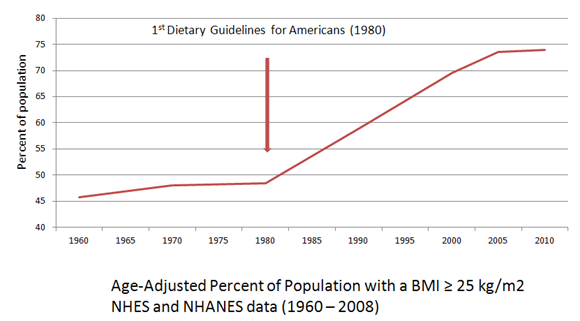
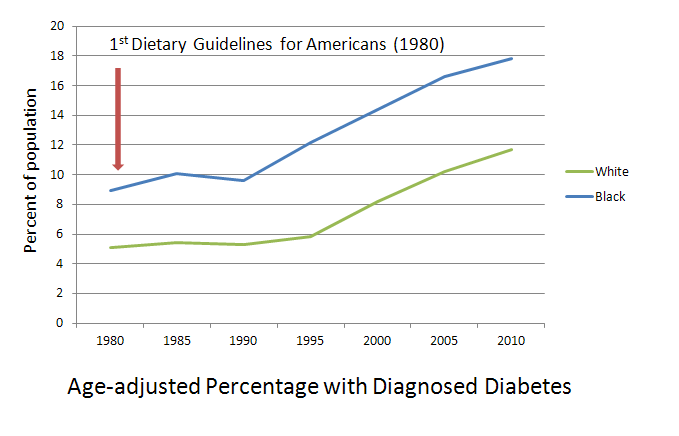
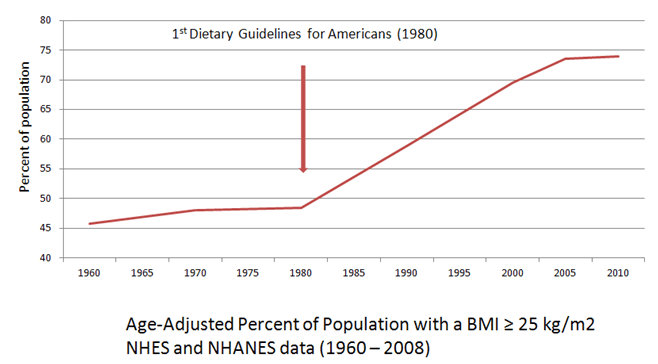
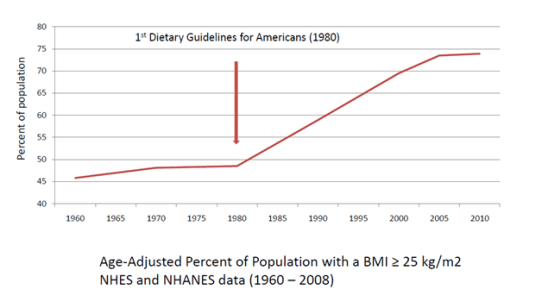
Since 1980, Americans have gotten progressively more lazy and gluttonous. As if this were not bad enough, apparently about 2/3 of the population—the fat 2/3 of the population—have also become unrepentant liars. Although we have no way to explain this precipitous decline in the moral fiber of Americans, we know it must be happening because Americans seem to be getting fatter and fatter even though many of these fat Americans report that they are not eating more calories than their normal-weight, honest, hard-working counterparts.
It seems that when we gave the USDA and HHS the responsibility for determining what food was healthy for each of as individuals, Government Approved Nutrition Experts also developed a magical ability (in Nutrition, we love magic!) to tell the difference between what was Truly True and what was a Big Fat Lie. Here’s a response I got to a food record assignment during an introductory Nutrition course:
| Question: What are your barriers to meeting the MyPyramid recommendations? (In other words, what might prevent you from consuming the recommended amount of each food group?) |
| My answer (after describing the low-carb diet that I used to lose weight and improve my migraines):I have a history of glucose intolerance and overweight/obesity. Past a certain point of consumption, carbohydrates make me gain weight, raise my blood pressure, reduce my energy levels, give me migraines, make my blood sugar wonky, and leave me hungry and cranky. I stick to fiber-rich, nutrient-dense, non-starchy vegetables for my carbohydrates, although I do eat fruit when it is in season locally. |
| Instructor’s response (I am not making this up): It is actually the total calories that make you gain weight, not the carbohydrates. The high fat intake would be more detrimental than the whole grains and fiber rich vegetables. Refined carbohydrates would cause the symptoms you describe but using whole grains and high fiber fruits and vegetables should not do so. You need carbohydrate for your brain to function. It does not function on fat and protein calories. In fact eating a low carbohydrate diet such as you describe would make you tired, give you migraines, make you hungry and cranky. |
Silly me! Of course the Nutrition Expert knows what REALLY caused my weight gain and migraines. Obviously the lack of carbohydrate to my brain prevented me from realizing her innate superiority at understanding and interpreting my own personal experiences. Either that or I’m just a Big Fat Liar.
Let me introduce you to another Nutrition Expert with the magical ability to tell Truth from Fat People Fiction–Michael Pollan:
Consider: When the study began, the average participant weighed in at 170 pounds and claimed to be eating 1,800 calories a day. It would take an unusual metabolism to maintain that weight on so little food. And it would take an even freakier metabolism to drop only one or two pounds after getting down to a diet of 1,400 to 1,500 calories a day — as the women on the “low-fat” regimen claimed to have done. Sorry, ladies, but I just don’t buy it. (Pollan M. Unhappy Meals)
The women in the Women’s Health Initiative (to which Pollan refers) are: Female. Post-menopausal. Overweight. From my experience at the Duke Lifestyle Medicine Clinic (director, Dr. Eric Westman), just about any woman who met those three criteria exhibited this sort of “freaky metabolism.” Not only is it possible for a woman in that hormonal situation to maintain her weight on 1800 kcals/day, it may be absolutely impossible for her to lose weight on 1400-1500 kcals/day—if she’s eating foods that enhance fat storage and prevent fat utilization (carbs, I’m lookin’ at you). In fact, not only did I see many other women like this in clinic, I stopped losing weight myself (at 185 pounds) eating 1200-1500 calories a day—and I wasn’t even postmenopausal. But then, at that point, I wasn’t a Nutrition Expert either. Not like Michael Pollan.
I always wonder why Mr. Investigative Journalist/Nutrition Expert Pollan didn’t go out find a few real live overweight, post-menopausal women and ask them what their personal experiences were with weight loss instead of simply discounting the experiences—and calling into question the humanity and integrity—of the “ladies” in the study. Oh wait, if the ladies he interviews are overweight, they’d all just LIE to him!
Anyway, why ask a real person, when you have Science on your side? Here’s a nutrition textbook explaination just how it is that we KNOW fat people lie:
Another approach to check for underreporting is to compare reported usual energy intake with resting energy expenditure calculated using various equations . . . If a subject’s reported usual energy intake is <1.2 times his or her calculated REE, underreporting of energy, and therefore nutrient, intake is highly likely. (Lee & Nieman, 2007).
In other words, if fat people don’t eat as much as we think they should be eating according to calculations that are known to be notoriously inaccurate, they must be “underreporting” (this is a complicated Scientific Term that means “lying about”) how much they eat. In my current Obesity class at UNC, Dr. Andrew Swick has confirmed—through evaluations done in a metabolic chamber—that some overweight/obese women have energy requirements as low as 1200-1300 calories (hmm, “freaky metabolism” maybe?), requirements that would be far below “calculated requirements” referred to above. Dr. Swick pointed out to us that some fat people don’t, in fact, eat that much food.
But we should never let reality stand in the way of Government Approved Nutrition Information (code name: GAIN). Our good buddies at the USDA and HHS prepared this helpful chart for the 2010 Dietary Guidelines Advisory Committee Report to show how many calories Americans are consuming compared to the recommended ranges:
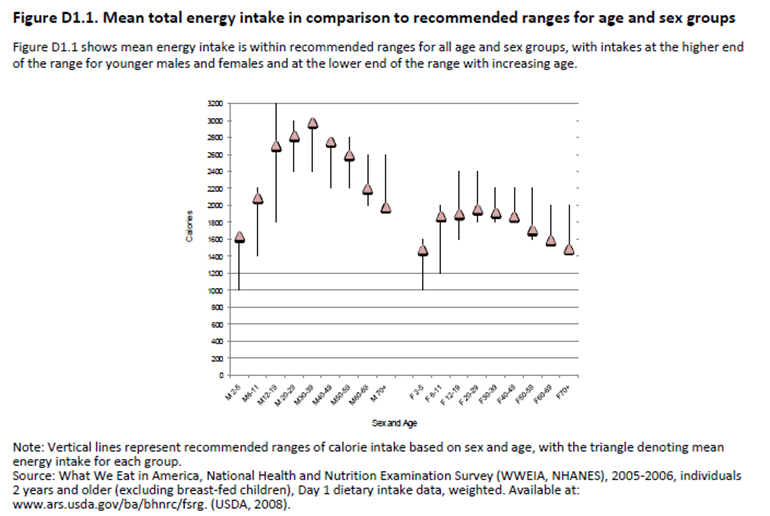
The vertical lines are recommended calorie ranges; the pink triangles are the average calorie intake in each group. Caloric intake appears to be within the recommended range for all age levels; adult women in general seem to be consuming at the very low end of their caloric range, about as many calories as a preschool male. That’s right, women over the age of 50 eat, on average, about as much food as 2-5 year old boys.
This must be more of that “freaky metabolism” thing to which Mr. Pollan refers. Or—wait—maybe they are all just LYING (the old ladies, not the little boys): the 2010 Dietary Guidelines for Americans go on to say, “While these estimates do not appear to be excessive, the numbers are difficult to interpret because survey respondents, especially individuals who are overweight or obese, often underreport dietary intake.” And we know what “underreport” means, right?
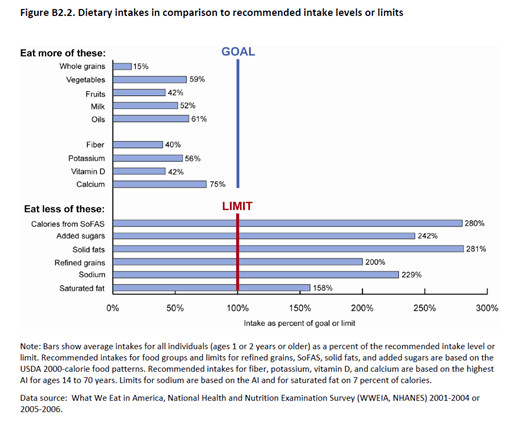
According the USDA and HHS, Americans aren’t fat because they are told to eat foods they don’t need to eat, Americans are fat because they eat too much–and then lie about it.
So, let me sum this up for the folks at home:
Fat people say that they don’t eat more calories than their normal weight (and apparently morally superior) counterparts. But we know they are lying because Nutrition Experts—like Michael Pollan—KNOW how much fat people eat should be eating (i.e. A LOT of food—otherwise, golly, they wouldn’t be so darn fat). ). He KNOWS this because he’s a Nutrition Expert and because we have scientists who have calculations that tell us how much fat people are supposed to eat (i.e. A LOT) so when fat people say they don’t each as much as scientists think they eat (i.e. A LOT), well then, the only possible explanation for that is that the fat people are LYING! And if that’s not enough evidence for you (and really, it should be), you can absolutely believe that that fat people LIE about how much they eat because the Government says they do.
And the government never lies.
References:
Lee RD and Nieman DC. Nutritional Assessment, 4th ed. Boston: McGraw Hill, 2007.
Pollan M. Unhappy Meals. The New York Times Magazine, January 28, 2007
U.S. Department of Agriculture and U.S. Department of Health and Human Services. Report of the Dietary Guidelines Advisory Committee on the Dietary Guidelines for Americans, 2010. June 15, 2010.
U.S. Department of Agriculture and U.S. Department of Health and Human Services. Dietary Guidelines for Americans, 2010. http://www.cnpp.usda.gov/DGAs2010-PolicyDocument.htm Accessed January 31, 2010.















 Eathropology