N of 1 Nutrition Part 2: Biochemistry and Nutrition Policy – The Great Divorce

Full disclosure: I happen to love biochemistry. I have a favorite transcription factor (ChREBP) and a favorite neurotrophic factor (BDNF). I think proteins are beautiful. If I were a biochemist who had discovered a novel protein, I would carry a picture of it around with me in my wallet.

An absolutely fabulous (looking) protein.

The animal and cells models used in biochemistry are great for looking at genetics, epigenetics, at biological mechanisms, and how these things interact. We can manipulate these models in ways that we can’t with humans, and this has given us some crucial insights into mechanisms, especially neural and epigenetic ones—critical to understanding the effects of nutrition—that would be virtually impossible to study in humans.

Nutritional biochemistry can also wear the mantle of “objective-er than thou” when it comes to science. As one of the biochem profs at UNC noted: If you have to use statistics to discuss the results of your experiment, you need to redesign your experiment. Sure, the questions asked, the interpretation of results, and what gets published in biochem are influenced by funding sources, social/scientific contexts and dominant paradigms. But unless you are a truly bad scientist, you can’t make the experimental results come out in a way that supports your hypothesis.

(This is in marked contrast to observational studies in nutrition epidemiology where the whole point of the data analysis “experiment” is to find results that support your hypothesis. Sometimes you don’t find them, and those findings should be reported, although they may not be because who’s to know?  Just you and your SAS files. My point is that you are actively seeking results that confirm a particular idea, and this just might influence what “results” are found. More on this in another post.)

But beyond the utility and elegance of nutritional biochemistry, the problems with regard to health policy are two-fold.

The first problem: In many ways, nutrition policy has become almost completely divorced from the basic science investigations done in biochemistry. The Dietary Guidelines Advisory Committee (DGAC)—the committee of scientists that, at least theoretically, reviews the science upon which the US Dietary Guidelines are based—started in 1985 as mostly MDs and biochemistry professors. As time went on, the DGAC became more heavily populated with epidemiologists. This would be fine if epidemiology was meant to generate conclusive (or even semi-conclusive) results. It isn’t. Epidemiology gives us associations and relationships that are meant to be understood through a reasonably plausible, preferably known, biological mechanism. Note these interesting conclusions from the 2010 DGAC Report and the 2010 Dietary Guidelines policy document with regard to dietary cholesterol:

Here’s our mechanism: Exogenous, or dietary, cholesterol down-regulates cholesterol synthesis in the liver to maintain cholesterol balance.”
[D3-1, Reference 1, emphasis mine]

Here’s our epidemiology: Traditionally, because dietary cholesterol has been shown to raise LDL cholesterol and high intakes induce atherosclerosis in observational studies, the prevailing recommendation has been to restrict dietary cholesterol intake, including otherwise healthy foods such as eggs.”
[D3-2, Reference 1, emphasis mine, “induce”? really? how does one “observe” that cholesterol “induces” atherosclerosis? I’m assuming committee fatigue had set in at this point because that word should have been “are associated with”]

Here’s our policy recommendation: Consume less than 300 mg per day of dietary cholesterol.”
[Ch. 3, p. 21, Reference 2]

See, wasn’t that easy?

This brings me to the second problem, which is sort of the flip-side of the first: Biochemical processes that are understood primarily through mouse or cell models only work as the basis for dietary recommendations for chronic disease if you’re making them for cells or mice.

As one of my favorite professors in the Nutrition department likes to quip, “We know how to cure obesity—in mice. We know how to cure diabetes—in mice. We have all the knowledge we need to keep our rodent population quite healthy.” Obviously this knowledge has not been translatable to humans. In some ways, basic nutrition biochemistry should be divorced from public health policy.

The reason for this is that the equivalency of animal models to humans is limited in ways that go beyond simple biological comparisons—although the biological differences are significant.

Mouse large intestinal tract, courtesy of Comparative Anatomy and Histology: A Mouse and Human Atlas, edited by Piper M. Treuting, Suzanne M. Dintzis

My knowledge of comparative physiology is limited at best, but my understanding is that most rodents used in nutrition biochemistry work (rats included) have a cecum (an intestinal pouch that facilitates the breakdown of cellulose), an adaptation that would be necessary in a diet composed of hard-to-digest plant material such as seeds and grains. Because this process is not terribly efficient, many rodents also recycle nutrients by eating their feces. Humans don’t have a functional cecum for fermentation; we don’t tend to reingest our own poops (or anyone else’s poop, unless you’re starring in a John Waters film) in order to extract further nutrition from them as our bodies are already very efficient at this during the first go-round.

Furthermore, due to inherent difference in physiology, animals may not accurately model the physiological conditions that produce disease in humans. For example, in some species of rodents, a high fat diet will induce insulin resistance, but there is no definitive evidence that higher fat intake per se impairs insulin sensitivity in humans [3]. Why this is so is not entirely clear, but likely has something to do with the diet each species has consumed throughout its evolution. In a natural setting, rodents may do well on a diet of mostly grains. On the other hand, humans in a natural setting would do okay on a diet of mostly rodents.

What is more critical is that animal and cell life can’t imitate the complex environmental inputs that humans encounter throughout their lives and during each day. Animals and cells only get to consume what they are given. If you’ve ever been at a conference where the breakfast is low-fat muffins, whole grain bagels, fat-free yogurt, orange juice, and fruit, you know what that feels like. But typically our food choices are influenced by a multitude of factors. Mice, unlike humans, cannot be adversely affected by labeling information on a box of Lucky Charms.

Mice don’t know that whole grains are supposed to be good for you.
Bad on them.

Does that matter? You bet it does.

Where do most Americans get their nutrition information these days? From media sources including the internet, from their grocery stores, from the packages holding the food they buy. People who have never read a nutrition book, much less the actual Dietary Guidelines, still “know” fat is bad and whole grain is good [4, 5]. These environmental exposures affect food choices. Whether or not the person still decides to consume food with a high fat content depends on another set of cultural factors that might include socioeconomic status, education, race or ethnicity, age, gender—in other words, things we can’t even begin to replicate in animal or cell models.

Human biochemistry is unique and complex, as are our social and cultural conditions, making it very difficult to study how these primary contributors to health and food choices are related to each other.

Can we do a better job with nutritional epidemiology? I know you’re on the edge of your seat waiting for the next episode in the unfolding drama, N of 1 Nutrition, when we get to hear Walter Willett say:

“I never met a statistical man I didn’t like.”

Stay tuned.

References:

1. U.S. Department of Agriculture. Report of the Dietary Guidelines Advisory Committee on the Dietary Guidelines for Americans 2010. Accessed July 15, 2010. http://www.cnpp.usda.gov/DGAs2010-DGACReport.htm

2. U.S. Department of Agriculture and U.S. Department of Health and Human Services. Dietary Guidelines for Americans, 2010. http://www.cnpp.usda.gov/DGAs2010-PolicyDocument.htm Accessed January 31, 2010

3. Report of the Panel on Macronutrients, Subcommittees on Upper Reference Levels of Nutrients and Interpretation and Uses of Dietary Reference Intakes, and the Standing Committee on the Scientific Evaluation of Dietary Reference Intakes. Dietary Reference 4. Intakes for Energy, Carbohydrate, Fiber, Fat, Fatty Acids, Cholesterol, Protein, and Amino Acids (Macronutrients). Washington, DC: The National Academies Press; 2005.

4. Eckel RH, Kris-Etherton P, Lichtenstein AH, Wylie-Rosett J, Groom A, Stitzel KF, Yin-Piazza S. Americans’ awareness, knowledge, and behaviors regarding fats: 2006-2007. J Am Diet Assoc. 2009 Feb;109(2):288-96.

5. Marquart L, Pham AT, Lautenschlager L, Croy M, Sobal J. Beliefs about whole-grain foods by food and nutrition professionals, health club members, and special supplemental nutrition program for women, infants, and children participants/State fair attendees. J Am Diet Assoc. 2006 Nov;106(11):1856-60.
N of 1 Nutrition Part 1: Same Old Tools

I’ve been thinking a lot about tools lately.  This actually has nothing to with the ongoing fascinating-in-a-train-wreck-sort-of-way paleo soap opera, although I have been reading Audre Lorde’s essay “The Master’s Tools will Never Dismantle the Master’s House” and loving it.  I have all kinds of things to say about feminism and nutrition (yeah, I’m going to go there), but there are all kinds of tools and we’re going to have to talk about all of them eventually.  Today, I’ll start with the scientific kind.  

At Ancestral Health Symposium 2012 there was, among other things, a great deal of discussion about what diet works “best:” primal, paleo, neopaleo (my friend Andrea invented that one), safe starch, low-carb, no-carb, etc. The reality is that, in terms of being able to make sweeping generalizations about which dietary pattern will work best for everyone, we as nutrition scientists and clinicians actually sorta suck. Other than describing very general recommendations for essential nutrition—amino acids, fatty acids, vitamins and minerals, and even these have a wide variability in individual requirements—we simply do not have the skills, the tools, or the knowledge to make sweeping dietary recommendations that do not come with the very real possibility of unintended negative consequences for an individual who might follow them.

Choline is a great example of what happens when you mix individual variation with universal recommendations:

Although our body makes some choline, we still require a dietary supply of this important nutrient.* Eggs are a primary source of dietary choline. The past 30 years of Dietary Guidelines have frightened us into reducing egg consumption and/or using egg substitutes that replace the yolk (where the choline is) with soybean oil in order to prevent heart disease, even though dietary cholesterol has little effect on serum cholesterol [1] and our average cholesterol intake is below recommended levels and has been for 40 years [2]. Nevertheless, egg yolks, a recent headline screamed, are as bad for you as cigarettes.

In response to these scare tactics, Americans have dramatically reduced their egg consumption [3]. As a result, average choline consumption does not meet current recommended standards; less than 4% of women even reach adequate intake levels [4, 5].

This is bad enough, but these adequate intake levels were based on a small study done on adult white males; standards for everyone else, including children, were extrapolated from those results [6]. Post-menopausal females, pregnant women, children, and people with certain genetic polymorphisms (which may exist in more than 50% of the population) may actually have increased needs for choline above and beyond the adequate intake level [7].

It’s hard to say exactly how large the gap between intake and actual needs are for these subpopulations, but I can hazard a guess that as long as whole eggs are discouraged as part of our diets, it will only continue to widen. The fact that dietary choline is needed for the development of  brain cells seems rather ironic in the face of such goofiness.

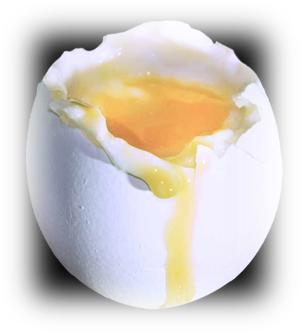
Brain food? Or death by cholesterol?

When dietary guidance shifted from being about provision of basic nutrition to prevention of chronic disease, we found ourselves using tools that were designed to examine diseases of nutrition deficiency (i.e. diseases with one fairly straightforward cause), to now make recommendations about chronic diseases with long, complex, multi-factorial origins [8]. Everyone deprived of Vitamin C will eventually develop scurvy, but not everyone who avoids cholesterol will also avoid heart disease.  Chronic diseases that result from a complex interplay between the individual and environment are difficult—if not impossible—to examine using our current tools and methods, and assessing an individual’s risk of heart disease and tailoring dietary guidance accordingly is much different from making population-wide recommendations to avoid a food–in this case, eggs–that is a primary source of an essential nutrient.

Our current approach takes the complex reality that is one individual human living his/her life and

  • dials into a discrete mechanism within this complex unit using cell cultures and animal models that can’t even begin to describe the physiological, psychological, and cultural context of a whole complicated individual (nutritional biochemistry), or
  • lumps a complicated individual into a pile with a lot of other complicated individuals and uses a fancy schmantzy computer program or a highly-controlled artificial experimental protocol to paint an simplified, homogenized broad brush stroke of a picture that bears little resemblance to the reality of any of the specific individuals it is supposed to describe (nutrition epidemiology), and then
  • turns these overly-simplified, homogenized descriptions into one-size-fits-all nutrition policy that has never actually been shown to work.

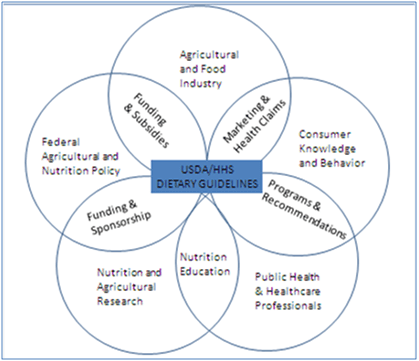
From reality to policy: Four perspectives on nutrition

Everyone is subject to the same biochemical rules—and it’s great to learn more about how these rules work on a mechanistic level—but how those rules play out in any given individual is difficult to predict. Is there a way to use the focus of an experimental intervention without losing the environmental influences present in observational studies, and still create something that will eventually translate into meaningful policy?

Maybe. In next few posts, I take on some of the shortcomings in our current methodology and explore an approach that may help move nutrition science, and thus nutrition policy, into the 21st century.

*Choline acts as a methyl donor in pathways involving gene expression and other metabolic functions; as an important contributor to structural integrity and signaling function in cell membranes, especially those involved in nervous tissue and brain development; as a necessary constituent of lipid metabolism and transport, including VLDL required for the export of fat from the liver; and as the precursor to the neurotransmitter, acetylcholine.

References:

1. Willett, Walter. Nutrition Epidemiology, 2nd edition. 1988.

2. U.S. Department of Agriculture. Report of the Dietary Guidelines Advisory Committee on the Dietary Guidelines for Americans 2010. Accessed July 15, 2010. http://www.cnpp.usda.gov/DGAs2010-DGACReport.htm

3. U.S. Dept. of Agriculture, Office of Communications. 2001-2002 Agriculture Fact Book. Washington, DC:2003.

4. Jensen H. Choline in the diets of the US population: NHANES, 2003-2004. The FASEB journal: official publication of the Federation of American Societies for Experimental Biology. 2007;21(Meeting Abstract Supplement):lb219.

5. Moshfegh A. Usual Nutrient Intakes of Americans. USDA Whitten Building; 2009.

6. Dietary Reference Intakes for Thiamin, Riboflavin, Niacin, Vitamin B6, Folate, Vitamin B12, Pantothenic Acid, Biotin, and Choline [Internet]. [cited 2012 May 21]. Available from: http://books.nap.edu/openbook.php?record_id=6015

7. Zeisel SH, da Costa K-A. Choline: An Essential Nutrient for Public Health. Nutr Rev. 2009 Nov;67(11):615–23.

8. Harper AE. Killer French Fries. Sciences 1988, 28 (Jan/Feb): 21-27.


Calories? Again? Already?

Are we not sick of this subject already?

There have been some excellent articles and lots of “food for thought” on this topic recently.

Robb Dunn did a guest post at Scientific American about “The Hidden Truths About Calories,” which—to summarize in a way that does no justice to the article at all—basically boils down to the fact that most of the hidden truths about calories are so hidden we simply don’t know much about them at all. (I second this: Why Calories Count Fo’ Shizzle.)

Go Kaleo has a great post on this topic called “Putting the (Calorie) Pieces Together.” 

And Regina Wilshire has a puzzle for us at Weight of the Evidence called “Working Through A Stall.” 

Sooooooo – do calories in general matter, or is only the “kinds” of calories (i.e. the “good” kind vs the “bad” kind) that matter?

I think Go Kaleo said it very well: “All that black and white thinking has got people believing a false dilemma: It’s EITHER ‘calories in vs. calories out’ OR ‘the kind of calories you eat’ that matters!” She’s right in saying that it is a false dichotomy.

Neither approach comes close to acknowledging the complex interplay of factors that is human metabolism. I’m down on the calories in/calories out paradigm because it is so limited in scope, but I am equally down on any paradigm that says they don’t matter at all.

There are far too many unknowns about how the energy content of the food we eat interacts with the energy needs of our bodies to insist upon a singular health-maintenance paradigm based on “calories in, calories out.” At the same time, there are far too many unknowns about insulin metabolism (we currently don’t even have agreed-upon ways to measure and discuss insulin dysregulation) to create a new singular health-maintenance paradigm based on “fat in, carbohydrates out.”

One thing that complicates the picture is that we equate the metabolic situation that causes fat gain with the metabolic situation that will induce fat loss. My understanding of the biochemistry is that there are two necessary aspects to weight gain: excess calories to store (although we seldom know how to measure or even estimate what we mean by “excess”) and the insulin signal that provides the mechanism for storage to take place. Remove one of these factors—again with the caveat that we have a limited understanding of what “excess calories” means—and you won’t have weight gain.

Weight loss may be a different matter entirely. For weight loss to take place, we have to figure out NOT ONLY how to not create a metabolic situation where these two factors are at play, we also have to figure out how to convince our body to reverse the fat-storage process. This may involve processes which go beyond just one eliminating insulin-stimulating carbohydrate foods because—unless someone has Type 1 diabetes—some basal levels of insulin (and we may or may not know what they are or if they are “normal” or how that matters) are always present. This may also involve processes which go beyond just eliminating “excess” calories because, as I hope I’ve made clear, we don’t really even know what that means.

Some people can reduce overall calorie intake and lose weight (this usually also involves a lowering of carbohydrate foods that stimulate insulin release) ; some people can just reduce their carbohydrate food intake  and lose weight (this usually also involves lowering calories available for storage); some people have to do both–deliberately and carefully—in order to lose weight. The trick is how to do this without

  1. inducing willpower-withering hunger pangs
  2. depriving the body of essential nutrition
  3. creating other metabolically-unfortunate side effects/consequences.

The answer will not be the same for everyone. Reducing the number of nutritionally-empty carbohydrates gets at both the calorie and the carbohydrate issue–so that’s sort of a no-brainer, but carbs and calories are not all that matter.

Like what?

Metabolism matters. Nourishment matters. Information signaling—provided by your body’s encounters with the environment, including food encounters–matters.

Do calories affect these things? YES!!! Do carbs affect these things? YES!!! Are there about a bazillion other things that affect these things? YES!!!

When the clinic doors at the Duke Lifestyle Medicine Clinic open, the first two patients through those doors were both very much alike and radically different.

Both were “obese” adult white males, but that’s about where the resemblance ended. One gentleman, who was almost as big around as he was tall, was actually pretty healthy. Most, if not all, of what we think of as meaningful or predictive health biomarkers (blood pressure, cholesterol, glucose, etc) were normal. His problems were primarily orthopedic; i.e. his weight was impacting his hip and knee joints.

The other gentleman was far less obese, but his weight (as you may guess) was concentrated in his abdomen, his predictive health biomarkers were in the toilet, and he had a bag of prescriptions meant to normalize those biomarkers to prove it.

I (now) think of the first gentleman as having “simple” obesity and the second gentleman as having “metabolic” obesity. Such fat patterning has also been referred to as gynoid obesity (“pear”) and android (“apple”) obesity, and the different health consequences of each have been recognized, but even these differences are over-simplified concepts.

Android obesity (Gentleman #2) has been associated with excess insulin and with more metabolic derangement than gynoid obesity. It has been fairly well explained at this point that, aside from its role as a fat storage mechanism, excess insulin causes other metabolic problems.*

Is gynoid obesity (Gentleman #1) primarily associated with “excess” calories or “excess” storage of calories, rather than insulin dysregulation? We don’t know. Can “excess” calories cause other problems besides those leading to fat storage? We don’t know that either. One of the problems with asking these questions is—again—how we define “excess.”

Either way, the next step is to recognize that how we address different types of obesity may also need to be different. One type of obesity may be best addressed by a focus on reducing carbohydrate intake. The other type could be addressed by a focus on decreasing calories in and increasing calories out—however you want to do that. (As above, either approach involves some aspects of the other.)

But even differentiating dietary approaches based on fat-patterning must acknowledge that if there is a spectrum—with simple obesity on one end and metabolic obesity on the other—that any individual can be located anywhere along that spectrum and thus a combination of approaches would have to be used to address the needs of the individual, which may need to go beyond both carbs and calories.

It is crucial to remember that our bodies not really designed to either “gain”or “lose” weight, but to respond to our environment by small shifts in– up-regulating and down-regulating—the production of proteins, enzymes, and other biomolecules to meet the pressures of the environment. We are adapted to adapt. Food is one of the primary signals our bodies get about our environment. Food lets the body know what the conditions are like “out there” so that we can make appropriate adjustments “in here.” These adjustments, we know now, can be passed on from one generation to the next, so that our offspring are also prepared for what is “out there.”

What the body is looking for—all the time, without exception—is essential nourishment and adequate energy (and again our definition of “adequate” is as problematic as our definition of “excess”).  Note to paleo-thinking readers:  the origins of the paleo diet emphasize acquiring essential nutrition, rather than forbidding non-essential foods. This point may be the most important aspect of ancestral nutrition. (And thanks to Katherine Morrison for calling this to my attention.)

An eating pattern that conveys to our body that the environment is lacking in either of these things is going to result in metabolic adjustments to this information. What the adjustment looks like is going to depend on genetic factors (What food environment were your ancestors adapted to?), and epigenetic factors (Did you have an adequately-nourished mom?), and previous adaptive adjustments (Does your body regularly have to respond to caloric highs or lows? to regular bouts of intense energy expenditure? to reduced nutrition?), in addition to those other bazillion things we don’t know about yet.

So what are we going to do about it? I am so glad you asked. I’ve been trying to work my way to a blog post about n of 1, or individualized nutrition, for weeks now. I think I’m about there.

*See the work of Gerald Reaven and Wenhong Cao, for example.

From Paleo to Public Health: We have met the enemy and we are them

Believe it or not, when I started this blog post, I wasn’t even thinking about the current sturm und drang in the paleo community. If you follow the paleo world gossip, you already know about it; if you’re not, this cartoon from xkcd.com says it all:

So—speaking of drama—social change stories are often built around drama triangles—also called triangles of power. In these triangles, there are three roles: victim, perpetrator, and rescuer. These roles can morph and change over time and depending on who is telling the story or who the audience is. In addition, a person or entity can be in more than one role at a time. [Note: This doesn’t mean that anyone actually IS a victim, perpetrator, rescuer; this is a construct used to describe a social dynamic, not enforce one.]

From the works of Eric Berne and Stephen Karpman.

We can think about this model in regard to the current commotion in the paleo community, but–more to my point–also in regard to the work we may be able to do as a community should we decide to get our collective act together and worry about something larger than ourselves for a while. (Perhaps we’ll need social media group therapy, culminating in a giant Skype conference call, where everybody joins twitter feeds and sings Kumbaya?)

There is value in the power of story-telling; the drama is part of what makes us want to be involved in cause. We can typically identify with the victim or the rescuer, or both; the perpetrator gives us a bad guy in an undeniably black hat on which to focus our things-we-love-to-hate passion. Policymakers often prefer stories to logical arguments; many of us do. But stories can also create false simplicity and black and white reasoning. They can create artificial walls and boundaries. Most dangerously for the nutrition reform movement, these stories can create a lack of respect for those we are trying to help (“We know what is best for you”) and a lack of humility with regard to our own fallibility (“We have the “right” answers this time”).

As nutrition reformers—from paleo to public health—what story are we going to tell?

We must be sensitive in our choice of who we place in the “victim” role. The “victim” is the one that pulls at our heartstrings, that gives the story its emotional weight. I think the real victims in the nutrition reform story are our next generation, the children who are not yet born but who will bear the burdens of a broken food-health system as much of the American public gets caught in a cycle of being misled, misfed, misdiagnosed, and mistreated. These are children who will grow up in a nation where the dream of good health belongs to a fortunate few and slips from the grasp of everyone else despite all good intentions and efforts otherwise. And because these particular victims don’t exist (yet), it saves us from the awkward position of “rescuing” people who don’t consider themselves to be victims.

Some people who are suffering from obesity and poor health today (some of us even) may see themselves as victims and choose to use the sense of outrage at being put in that position to help change the system. But not everyone will choose that role, and I suggest we not take the stance that “poor fat sick people” out there need our help.

It isn’t as if we have a shortage of casualties from the past 30-40 years of USDA/HHS dietary guidance. How about the environment, small farmers, taxpayers, or maybe the scientific integrity of a whole generation of nutrition scientists? In 1978, Dr. Al Harper, from the University of Wisconsin-Madison, warned that the Dietary Goals’ promise of better health for all with no risks, only benefits, had ” great potential for undermining both the science of nutrition and nutrition education” [1]. It would seem that to a large extent, he was right. As a nation, we’ve lost a lot in thirty years.

So who is to blame? Hmm. Good question.

Government?

Policymakers doing what policymakers do: making policy.

Well, it is hard to pin this all on a disembodied “government” because the government does what we allow it to do. As long as we the people allowed segregation, it continued. When we decided that segregation was no longer tolerable, laws were created to end it. Changing attitudes will change the institutions that in turn shape attitudes.

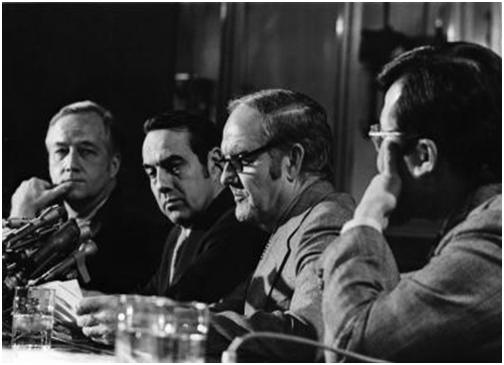
It doesn’t make a lot of sense to blame “the government,” when the general public has not developed a mature sense of healthy skepticism towards the government’s ability to protect us from ourselves. When the first Dietary Goals were released by the McGovern Committee in 1977 and the first Dietary Guidelines released by the USDA in 1980, the public could have refused to believe the low-fat-jello-pie-in-the-sky promises, but they didn’t—for reasons that may be more cultural than scientific in nature. I’m not convinced we would do so under similar circumstances today. Although we may now be more wary of the government’s ability to solve our problems, we tend to still hold out a childish hope that it will anyway. [Funny, to me anyway, story: It seems that a number of us who showed up for the paleo-libertarian dinner at AHS2012 were there less because of our libertarian ideals and more because we were happy to have someone else choosing our dinner destination and making reservations for us. Just a touch of irony there.]

In 1977 and in 1980, policymakers were applying the information that they had at the time to a well-intentioned goal of improving the health of all American; this is just the type of thing we expect from our policymakers. Did they seem to favor one side of the argument? Sure, but do we really think that—if we were in their position—we could work with complete objectivity? We couldn’t; there is no such thing. As we try to change public opinion and government policy, we will be working under the same constraints of humanness they were, with the only added advantage being that we can learn from the unintended consequences of these good intentions.

Industry?

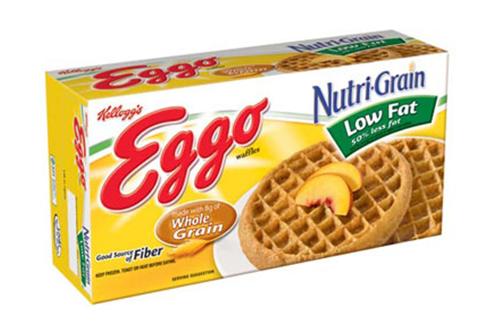
Low-fat, whole grain, fiber-filled box of food: more nutrition information than actual nutrition.

Should we blame “the food industry”? We could.

Gary Taubes tells the story of one of the staff members of the McGovern Committee being approached by an industry analyst who tells him, “if you think people are going to start eating more broccoli and more kale and spinach because you’ve now put together dietary goals, you’re crazy. What you’ve said is people should eat less fat so the industry is going to jump on this and they’re going to create low fat products and they’re going to label them as heart healthy or whatever and they’re going to be able to carve out a portion of the market for their new products and everyone else is going to have to play catch-up and that’s what they’re going to do and the next thing you know you’re going to have shelf after shelf in the supermarket of junk foods that claim to be low fat and good for your heart.” As Gary Taubes points out, that’s exactly what happened. But is this the fault of industry?

Industry follows laws of supply and demand, using government recommendations as a marketing tool. Americans were happy to consume the products designed to lower our cholesterol and prevent heart disease then, because we thought doing so would contribute to good health. Now we, as a community hoping to expand our influence out to the rest of America, are happy to consume gluten-free snacks, grass-fed beef, and pemmican—for the exact same reason, because we think doing so will contribute to good health. We might have been sold a bill of goods by the food industry in the past 30 years, but by golly, we bought it.

Addressing the economic engines that make our food-health system go around is part of our challenge in shifting the paradigm. Working with the producers, especially the one at the bottom of the industrialized food chain, and the retailers, who must meet changing consumer demands—rather than lumping everyone together and clamping a big black hat on the whole thing—is a lot more likely to lead to success.

If there is a lesson to be learned here, maybe it is that we should be cautious about what health information we allow to be used on packaging and marketing, no matter what the nutrition paradigm. I don’t agree with Marion Nestle on much, but I agree with her that a box of food is no place for a tutorial on nutrition.

Science?

The only really bad scientists I know.

What about “bad science”? Isn’t that what got us into this mess?

I get the impression that a lot of us would like to blame “mainstream” nutrition—whomever or whatever that is—and the “bad science” it produces. I would offer some strong caution against this.

We want a different nutrition paradigm–specifically “our” paradigm, whatever that will be–to be “mainstream” one day, but it is a very tenuous position to say “they got it all wrong, but don’t worry, this timewe got it right.” All scientists are both trying to make a living and trying to improve the health of Americans. No scientist can control how his/her work is used (or misused) for public health policy. The scientists who have contributed to our current nutritional paradigm have been working–as all scientists do–within a framework shaped by personal experiences, cultural forces, financial pressures, political and career concerns, powerful individuals, and media soundbites.  The next generation of scientists will be no different. When scientists are asked to work on committees that create policy, they do, of course, bring to that work a more comprehensive understanding of their own area of study than of an area that offers a competing view.  The practices behind policy-making are responsible for making sure such views are balanced, not the scientists themselves.

In the early years of the Goals and Guidelines, a number of scientists did complain about the prematurity of those recommendations. I think most of us would like to think we’d be among those skeptics, but I’m not sure that we would. For the most part, people who then worked in the field of nutrition— dietitians, clinicians, young scientists—embraced these new dietary recommendations as progressive and much needed. Dr. Joanne Slavin told me the story of how the younger generation in her Department of Nutrition at the University of Minnesota thought Dr. Harper (see the quote above) was “behind the times” because he didn’t think it was such a great idea to tell everyone to reduce their fat intake. When we established policy to give an institutional framework to an ideal that was waiting for the science to catch up with it, we failed to prepare for the possibility that we might be wrong. If there is one lesson to learn from the past 30 years of interaction between nutrition science and public health policy, it is that we should prepare for that possibility.

Us?

To a large extent, the cultural forces that shaped our thinking about nutrition (and which in turn helped carry the scientific, policy, and industrial forces forward) were an extension of the culture wars of the 60s and 70s: suits vs. hippies. The suits (maybe the “lab coats”?) were the stodgy pinhead scientists, fiddling away in their labs, waiting to get the science “right,” while the country went to hell in a hamburger. The “hippies” of the McGovern committee—along with popular figures like Frances Moore Lappé, author of the wildly popular vegetarian cookbook, Diet for a Small Planet –saw changing the diet of Americans as a moral imperative that eclipsed concerns over the weak associations with diet and disease outcomes. This gave the low-fat diet an Age of Aquarius glow that offered a shiny new hope for ending chronic disease, and we swallowed it hook, line, and sinker.

Labeled the “barefoot boys of nutrition,” the creators of our first national dietary recommendations were a team of young, energetic, long-haired (for DC anyway)—and not coincidentally, white, well-educated, upper/middle class and male—idealists hoping to convince Americans to eat a more “natural” diet, a vision of the lead writer for the group, Nick Mottern, who remains a staunch advocate of minimally-processed foods (and who has never, by the way, been a vegetarian) [2,3]. With the exception of the food from animals vs. food from plants orientation (and I think we have more women in places of influence), how different is the paleo community from these origins?

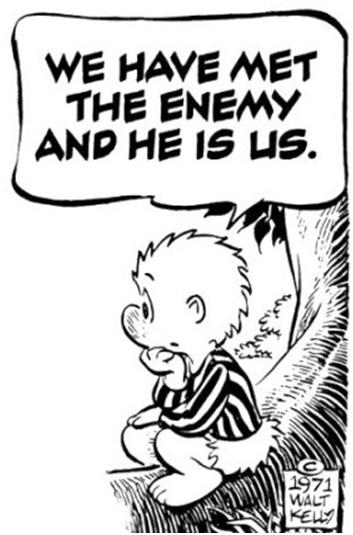
In other words, in the immortal words of Pogo: We have met the enemy and he is us. “Us” is (upper) middle class, well-educated, young white people with an idealistic plan to change the world for the better. Now of course I don’t mean you or me personally. We can all find ways to excuse ourselves from this stereotype (I for one can claim that I’m not young—but otherwise, the description pretty much fits me exactly). But there is a lesson here to be learned: in creating an “enemy” to fight in the nutrition revolution, we had better choose very carefully. Let’s choose an “enemy” we actually want to eliminate permanently (i.e. not us).

I suggest that we not make a person, a group, an entity, or an institution either scapegoats or the enemy. Then who or what is to blame? What do we want to get rid of entirely?

Well, how about poorly-designed policy? Maybe one-size-fits-all guidelines (assuming we can agree that this concept should be eliminated)? Maybe a food-health system that lacks transparency, public involvement, and checks and balances? Maybe we could get rid of the framework that excludes the concept of food culture from any discussions about food policy?

If we can do that, it opens up the last piece of the triangle–the “rescuers”–to anyone who cares about the health of Americans: policymakers, health professionals, the public, food producers and manufacturers, scientists (even the nutrition epidemiologists whose science many of us love to hate), or, umm, maybe even each other.   If we can see a place for all of these groups, and all of us already in the “alternative nutrition” community, in shifting the future of America away from policies that have created little hope for the health of our next generation, we may begin to see them as allies (or at least future allies), rather than enemies. As such, we can enlist their help rather than trying to blame them or defeat them.

Right now I’m thinking we may need to try this out in our own little paleo/low-carb/WAPF/etc. communities first.

1. Harper AE. Dietary goals-a skeptical view. Am J Clin Nutr. 1978 Feb;31(2):310-21.

2. Broad, WJ. Jump in Funding Feeds Research on Nutrition. Science, New Series, Vol 204. No. 4397 (June 8, 1979). Pp. 1060-1061 + 1063-1064.

3. Mottern, N. Correspondence.

From Paleo to Paradigm-Shift: Building a Nutrition Reform Network

Brief recap: What can we do to transform this paleo-led, Ancestral Health Society-supported community into the public health, human rights revolution it could be?

According to Doug Imig at the University of Memphis, a protest becomes a movement when:

1) It defines and proclaims widely shared cultural norms.

2) It creates dense social networks.

3) It gives everybody something to do.

The first part of this process can seem daunting. What “shared cultural norms” do we have with other movements and organizations? I’ve spent the past couple of years trying to find common ground, including a semester in Washington, DC where I met people from many different organizations interested in policy, food, and nutrition reform. I’ve also quizzed lots of folks within the nutrition science establishment about basic principles with which we can all (mostly) agree. What I’ve found has led me to propose the following “shared cultural norms”:

  • Open, transparent and sustainable food-health systems will benefit all Americans.
  • There is no single dietary approach that will result in good health for everyone.
  • Nutrition messages are constructed and have embedded values and points of view.

[For an expanded discussion of these principles, see The REAL Paleo Challenge.]

“Shared cultural norms” become shared goals, and with shared goals, we can move together in one direction. Leading—and following—with humility and generosity will go a long way towards the next step: creating a large, dense social network of people willing to work together toward these common goals.

So let’s first take a look at the humility and generosity thing:

For paleo leaders, this begins at home. If you don’t write your own blog posts or research all your own material, be up front about the fact. Give credit to those who do the work for you. Believe it or not, there are people out there—your readers—who think that you do ALL of that work. Letting them know you don’t—and giving a name and a face to the people who help you out—takes you off a pedestal and lifts up the folks in the background. Don’t worry; there’s room enough for everyone. If inspiring people to get fit and healthy is your thing, inspire them to look at the bigger picture too. Insist on scientific integrity from yourself and others. Everybody makes mistakes, overstates the facts, fails to fact-check a source thoroughly or read the original materials carefully and critically; sometime new evidence or a new perspective changes our minds. Be humble in your claims about what food/nutrition can do and avoid nutritional scare tactics and absolutism. No one has all the answers.

For paleo followers, refuse to be captured and captivated by labels, leaders, controversy, and coolness. If thinking for yourself is what brought you to the paleo community in the first place, don’t check your brain at the door when you start listening to the folks you consider to be the experts. Don’t let the folks that you admire slide just because you agree with them or because you’re on the same side of the issue. If getting fit and healthy by following one of those inspiring leaders is what brought you, take it upon yourself to challenge them—and yourself—to look beyond personal health to the health of your community. Allow your paleo heroes to be human; no one has all the answers.

A sense of strength and unity within the paleo community will allow us to turn our sights and energies outward, rather than inward. I’m pleased to say that I think this has already begun. There has been a lot of reaching out to the other “alternative” nutrition communities, and I think we can give a great deal of credit to the folks at Ancestral Health Society for creating a space for this to happen. AHS and the paleo community is where the other alternative nutrition communities, Weston A Price Foundation and the low-carb folks, seem to intersect. At AHS2012, primalebrities Robb Wolf and Mark Sisson signed on as WAPF members and low-carb leaders Richard Feinman, Andreas Eenfeldt and Jimmy Moore were welcomed as respected members of the paleo community.

Robb Wolf and Mark Sisson truly leading the way to a paradigm-shifting network of nutrition reform. Photo courtesy of Ancestralize Me’s Laura Schoenfeld.

We can strengthen these connections by getting to know each other better, attending each other’s conferences, sharing information across groups and blogs, and by remembering that we are all working towards the same goals, even if our particular dietary approaches differ. We can all continue to support and promote AHS even if we don’t match the paleo template exactly. WAPF has a strong grassroots community; there is likely to be a chapter near you where you will find kindred spirits. I hope I don’t have to sell anyone on promoting Peter Attia’s and Gary Taubes’ NuSI once it is launched. For that matter, publicize the work of Healthy Nation Coalition (this would be my own agenda of course) and join us in trying to figure out ways to make this a long-term, self-sustaining social movement for everyone.

Cohesiveness within the movement will allow us to expand our diplomacy to other food and nutrition reform arenas. Remember, we don’t have to agree with everything another community may say or do, but if we have some common ground, we should build on it. Here are a few examples of organizations with which we may share common values (I’m sure you all can think of more):

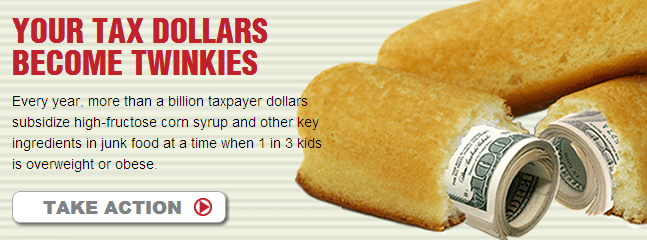
Common ground? Probably, unless you think Twinkies are paleo.

Paleo leaders, you can open your doors a bit more. Find out what you can do to reach across nutrition reform community boundaries. It will broaden your audience base and the reach of your nutrition message, as well as help create a network of like-minded groups. Put as much effort into finding common ground with those whose general perspective you are not sure you quite align with as you do into ripping up the science you don’t agree with. Although there is no reason not to call out poorly-designed and -reported science when it shows up, be humane, humble and transparent when you do. Frequently it is underlying policies and paradigms at fault (perpetuated by media coverage), not the science or the scientists per se. Paleo leaders, not only can you get a low-carb or WAPF leader to do a guest post or interview, you could invite a vegan to help you find common ground within your two communities. See what those folks in the permaculture groups are up to and publicize it. There is some ridiculously awesome stuff going on that just happens to be, by default, mighty paleo-like. We should be supporting projects like The Food Web because, although not everyone is going to want to raise chickens, if we are going to talk sustainability, animal welfare, and support for small farmers—and I hope we are—the folks in the permaculture community are where the rubber meets the road.

Abe Connally and family explain permaculture at work. Result? A sustainable—and paleo—food system. Click on the picture to find out more.

For paleo followers: Reach across boundaries yourself—we have much to learn from each other and more similarity that we want to think we do. Next time you attend a paleo event and you see a person who doesn’t “look the paleo part,” go up to them and introduce yourself. Tell your story and listen to his/hers.  It actually might be more informative than standing in line to ask Mark Sisson if he thinks shirataki noodles are “primal.” Volunteer with AHS; join WAPF; check out Healthy Nation Coalition. We’re not cool or hip and frankly, our mission is more to get behind everybody else and push than get out front and lead, but we do good work.

And paleo followers, you can do something the paleo leaders can’t do (and isn’t that fun to know?). You can take this message out into your professional or academic world and treat it as a serious subject for closer examination in fields like: American studies, education, sociology, human development, maternal and child health, communication, ecology, political science, economics, psychology, health policy, etc. Doing this legitimizes the paradigm shift that is already underway. If you are concerned about sounding like a nutcase (because many outside of alternative nutrition communities have only been exposed to our default “healthy diet” definition), refer to the “shared cultural norms” above–they travel well. If we begin to look at the past 30 years of national nutrition policy as the cultural phenomenon that it is, we can begin to entertain the notion that perhaps it is time to move on.

Scientific measurements of skull sizes use to “prove” racial superiority? Science is shaped by culture; nutrition science is no different.

Consider Prohibition or the civil rights movement. Both were cultural events or paradigms where science was invoked to either defend or to undermine specific cultural norms. Our science has not magically become more “objective” since then; it is only in retrospect that we can see how cultural forces shaped the prevailing paradigms. Paleo followers can have that conversation in any arena that may be applicable, and use our dietary guidelines as an example.

Changing attitudes will change the institutions that shape those attitudes. But the biggest roadblock to shifting the paradigm remains.

A paradigm shift in—in science and in culture—must preserve, not trash, much of what has come before and recognize the advances made by those who have preceded us, even if (and maybe in this case, especially if) they are on the other side of the paradigm shift. Honestly, we have a really hard time with this, and I think this remains our primary challenge.

Next up: A place for everyone—including nutrition epidemiologists?

The REAL Paleo Challenge: How NOT to be Just Another Elitist Fad for Skinny White People Wearing Goofy Shoes

The blogsphere is beginning to rattle with commentary on the recent Ancestral Health Symposium 2012 events. Some folks who don’t necessarily “look the paleo part” have voiced concern about feeling excluded or marginalized as the conversation/social activities/celebrity parade seemed dominated by:

  • white people
  • young people
  • thin/athletic/fit people
  • men
  • well-educated, upper-middle class socioeconomic status people
  • people wearing goofy-looking shoes

You can read my take on why that might be the case here: AHS 2012 and the BIG BUTT: Lessons in Nutritional Literacy.

I understand that an NPR reporter was at the event, interviewing some of the movers and shakers. There was some concern that the reporter seemed to think that the paleo movement is a bit of an elitist fad. I understand this perspective, and on many levels, I agree.

As a “fad,” the paleo movement is a bunch of highly enthusiastic people with a lot of disposable income and time who are deeply committed to a particular way of being fit and healthy. It has its leaders, it controversies, its “passwords” (can you say “coconut oil” or “adrenal burnout”?), and its stereotypical paleo dude or dudette. As a fad, it would be destined to go the way of all of other diet and health fads—including Ornish and Atkins, Pritikin and Scarsdale, extending all the way back to the “Physical Culture” movement of the earlier part of this century (Hamilton Stapell spoke about this at AHS2012).

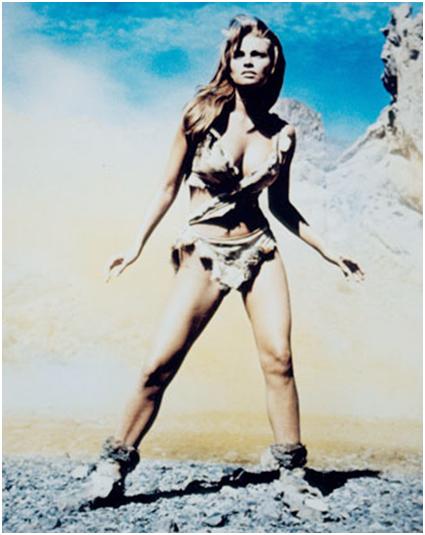
The original paleo chick – no high heels on this lady

Is it elitist? Well, there are some ways that it is possible that the paleo movement may marginalize the very folks who might benefit most from its efforts. Maybe an African-American guy still sensitive to the fact that his grandfather was consider “primitive” might not want to get his full cavemen on. Maybe a Mexican-American woman who remembers her abuela telling her stories about being too poor to have shoes doesn’t really want to go back to being barefoot just yet. Maybe an older, heavier person simply feels intimidated by all the young healthy fit people swarming to the front of the food line.

But the paleo movement does not have to be an elitist fad unless insists on limiting itself to its current form, and I believe the people at the Ancestral Health Society  are working hard to make sure that doesn’t happen. This is why I really love these folks. I don’t mean the paleo leaders like Mark Sisson or Robb Wolf, although I’m sure they’re good people; I’ve just only met them briefly. I mean those somewhat geeky-looking-in-an-adorable-sort-of-way folks in the brown T-shirts who hung in the background and made it all happen for us last week. Notice that they don’t call themselves the Paleo Health Society, right? I love them because they ask good questions, they question themselves, they think long-term, and they’ve created a community that allows these conversations to take place.

So, what do we do to transform this paleo-led, AHS-supported community into the public health, human rights revolution it could be?

According to Doug Imig at the University of Memphis, a protest becomes a movement when:

1) It defines and proclaims widely shared cultural norms.

2) It creates dense social networks.

3) It gives everybody something to do.

Each of these deserves its own blog post, so let’s look at the first—and most important—item: widely shared cultural norms. This is where the “elitist fad” part of paleo falls short, but not really. Because in all my encounters with paleo folks and people from AHS, I find norms and values that the culture as a whole can embrace. Here’s the weird thing, I’ve spend the past couple of years also talking to mainstream scientists, from one end of the diet spectrum to another, including Joanne Slavin, a down-to-earth, warm, wonderful lady who was on the most recent Dietary Guidelines Advisory Committee and Henry Blackburn, who is a delightful gentleman and a protégé of Ancel Keys. Guess what? We all have some values in common.

Here are some concepts that I think may unite us all, from vegan to primal, from slow food to open government, from “mainstream” scientist to “fringe scientists” like Gary Taubes (yes, one of my UNC instructors referred to GT as a “fringe scientist,” although another found his views “very convincing”—go figure):

We must create an open, transparent, and sustainable food-health system.

The RD that inspired me to take an internship at the American Dietetic Association for a semester, Mary Pat Raimondi, said: “We need a food system to match our health system.” And whatever shape either of those systems may take, she is absolutely right. Conversations about food must encompass health; conversations about health must encompass food.

Right now our food-health system is closed. Directives come from the top down, public participation is limited to commentary. The people who are most affected by our nutrition policies are the farthest removed from their creation. We need to change that.

Right now our food-health system lacks transparency. USDA and HHS create nutrition policy behind doors that only seem to be transparent. Healthy Nation Coalition spent a year filing Freedom of Information Acts in order to get the USDA to reveal the name of a previously-anonymous “Independent Scientific Panel” whose task, at least as it was recognized in the Acknowledgments of the Dietary Guidelines, was to peer-review “the recommendations of the document to ensure they were based on a preponderance of scientific evidence.” You can read more about this here, but the reality is that this panel appears to not be a number of the things it is said to be. This is not their fault (i.e. the members of the panel), but an artifact of a system that has no checks and balances, no system of evaluation, and answers to no outside standards of process or product. This must change.

Our food-health system must be sustainable. And Pete Ballerstedt would say, yes, Adele, but what do you mean by “sustainable”? And to that I say—I mean it all:

Environmental sustainability – Nobody wants dead zones in the Gulf or hog lagoons poisoning the air. But environmental sustainability can’t be approached from the perspective of just one nutritional paradigm, because a food-health system must also have:

Cultural sustainability – We are not all going to become vegans or paleo eaters. Our food-health system must support a diversity of dietary approaches in ways that meet other criteria of sustainability.

Economic sustainability – Our food-health system must recognize the realities of both producers and consumers and address the economic engines that make our food-health system go around.

Political and scientific sustainability – Our food-health system must become a policy dialogue and a scientific dialogue. Think of how civil rights evolved: an equal rights law was passed, then overturned, a Jim Crow law was passed, then overturned, an equal right law was passed, then upheld, etc. etc. This dialogue reflected changing social norms and resistance to those changes. But we have no way to have a similar sort dialogue in our food-health system.

What would the world look like if, in 1980, an imaginary Department of Technology was given oversight of the development of all knowledge and production associated with technology? Production of food and knowledge about food (i.e. nutrition) became centralized within the USDA/HHS in 1977-1980 and there have been no policy levers built into the system to continue the conversation, as it were, since then. The Dietary Guidelines have remained virtually unchanged since 1977; our underlying assumptions about nutrition science have remained virtually unchanged since 1977. That’s like being stuck in the age of microwaves the size of Volkswagens, mainframe computers with punchcards, and “Pong.” We need a way for our food-health system to reflect changing social and scientific norms.

One of the primary shifts in understanding that has taken hold since 1977 is that:

There is no one-size-fits-all diet that works for everyone.

In 1979, Dr. William Weil Jr at the Department of Human Development at Michigan State University, voiced concern about “the frequent use of cross-national and cross-ethnic inferences” [Weil WB Jr. National dietary goals. Are they justified at this time? Am J Dis Child. 1979 Apr;133(4):368-70.]  He went on to day that we cannot assume that “because ‘a’ and ‘b’ are correlated in one population group that they will also be correlated in another group” yet our one-size-fits-all dietary recommendations make just that assumption.

There were more scientific articles generated from the Nurses’ Health Study–composed of 97% white women–in 2009 alone, than in the entire 10+ year history of the Black Women’s Health Study. Those large epidemiological studies done with a mostly white dataset are what drive our policy making, even though evidence also points to fact that we should not be making the assumptions to which Dr. Weil referred. A landmark study published in 2010 shows that African-Americans who consumed a “healthier” diet according to Dietary Guidelines standards actually gained more weight over time than African-Americans who ate a “less healthy” diet [Zamora D, Gordon-Larsen P, Jacobs DR Jr, Popkin BM. Diet quality and weight gain among black and white young adults: the Coronary Artery Risk Development in Young Adults (CARDIA) Study (1985-2005). American Journal of Clinical Nutrition. 2010 Oct;92(4):784-93].

.

DQI stands for Diet Quality Index. Blacks with a higher DQI had more weight gain over time than blacks with a lower DQI. From Zamora et al.

Even with a more homogenous population, this issue applies. Remember all those discussions about “safe starches” you heard at AHS2012?

This concept also captures the emerging knowledge of how genetic variability affects nutrition needs and health, i.e. individualized nutrition, a very useful buzzword. I have lots to say about n of 1 nutrition coming up soon. But, most of all, not trying to cram everyone into the same nutritional paradigm captures reality of our own lives and choices about food. Which brings me to:

Food is not just about nutrition, and nutrition is not just about science.*

When we all begin to question our own assumptions about food and nutrition, we will be better able to reach across communities, create common ground, and be humble about our way forward.

We need to understand and help others understand that all nutrition messages are constructed and contain embedded values and points of view.

We need to learn to ask and teach others to ask: Who made the message and why? Who may benefit or be harmed? How might people interpret this message differently?

We need to think and help others to think about income and funding models, industry, and the framing of dietary problems by scientist, bloggers, and the media (and I don’t just mean “the other guys”—apply these critical thinking skills to your own nutrition/food community).

Nothing about our food and nutrition thinking was born in a vacuum. Food is a part of our cultural and social fabric. It allows us to belong; it allows us to define ourselves. Even as we strive to find better science and to shift our current diet-nutrition paradigm, we must approach this with the understanding that there is no truly objective science. How science gets used, especially in the policy arena moves us even farther from that non-existent ideal. Even as we strive to improve public health, we must understand that we don’t always know what “health” and “healthy food” means to the people we think we are trying to serve.

If these points sound remarkably like the mission statement for Healthy Nation Coalition, my non-profit, then you’ve been paying attention. But it is not my plan for HNC to “lead” any nutrition reform movement as much as it is for us to get behind everyone else and shove them in the same direction. There is very much a herding kittens aspect to this (as Jorge of VidaPaleo.com pointed out), but as a former high school teacher and mother of three, this is not new territory to me.

So, yes, I have an agenda. Everyone has an agenda. I’ll spell mine out for you:

Somewhere out there in America, today, there is a young African-American girl being born into a country where many—if not most—of the forces in her world will propel her towards a future where she will gain weight, get sick, have both of her legs amputated, get dialysis three times a week, be unemployed and unemployable, on disability and welfare, and—this is what gets me out of bed in the morning and drags my weary ass to one more round of getting punched in the face by those very forces arrayed against her—she will, somewhere underneath it all, blame herself for her situation. I’m an old white lady, in a position of relative power and knowledge. I don’t know this young lady, and she doesn’t know me. She doesn’t owe me anything because she’s not asking for my help. But it is my job in this life to begin—at the very least—to shift those forces so that she has a better opportunity to choose a different life if she wants to. That’s all I care about. I don’t care who gets credit or who gets the cushy book deal.  I just want it to happen.  I would want the world to do the same for my children if they had not had the privilege of birthright that they do. That child is my child as sure as the three that live here and drive me crazy are. All I ask of the paleo community is that she be your child too. And if, as a community, you decide to adopt this child, well then, don’t worry about becoming an elitist fad made up of goofy-shoe wearing white people destined to fade into obscurity. Instead, you all will change the world.

Next Up: What makes a movement? (and I mean a social change one, not the bowel-y kind)

*Much of what follows borrows liberally from the work of Charlotte Biltekoff at UC-Davis, a wonderfully warm and intelligent woman who has been working on and thinking about this issue for—believe it or not—longer than Gary Taubes. She has a book coming out next summer which, IMHO, will be the social/cultural partner to Good Calories, Bad Calories.

AHS 2012 and the BIG BUTT: Lessons in Nutritional Literacy

An anonymous butt of a close friend who gave me permission to use her rump to make a point.

The comments are starting to come in:  Ancestral Health Symposium 2012 was fun BUT (and it’s a really BIG BUT), the conversation/social activities/celebrity parade seemed dominated by:

  • white people
  • young people
  • thin/athletic/fit people
  • men
  • well-educated, upper-middle class socioeconomic status people
  • people wearing goofy-looking shoes

Some folks who did not fit into these categories very well are expressing that they felt excluded and marginalized. All I can say is, well, yup. It shouldn’t really surprise us, but it should give us an opportunity to look closely at why this is the case.

Buckle your seat belt—ask for an extension if you need one—it’s gonna be a bumpy ride.

Right now, “looking the paleo part” is important in the paleo community. Think: gorgeous Laura Schoenfeld  or any of the adorable white guys at AHS 2012—so ubiquitous and uniformly handsome as to be practically interchangeable (with my apologies to them all, as the individuals I did meet were charming and intelligent—yes, Dan Pardi, Colin Champ, and Ben Greenfield, I mean you). It is easier for you to become a valued member of a community if you look the part. Why? Because health, especially dietary health, is—for us middle class white people—a stand-in for character.*

“Looking the part” demonstrates to the world that you are, indeed, a “responsible good eater.” If you are overweight, if you have obvious health deficits, if you are not white, if you are old—you stray from the community’s ideal of a “responsible good eater”—no matter what your diet actually is. Not “looking the part” tars you, however subtly, with the brush of “unhealthy other.”

How did the concept of “unhealthy other” come to be?  The mainstreaming of nutrition science and the middle class’s current obsession with it emerged at the same time. The 60’s and 70’s brought us race riots, civil rights and equal rights marches, economic instability, political turmoil, sex, drugs, rock and roll, and really long lines for gas. It seemed for a while that the stature of the white middle class that was so securely ensconced in the Leave it to Beaver suburbs in the 50s was being flooded with “others,” on the verge of disappearing altogether into the muddy waters of social change.

Meat, veggies, tubers, maybe some dairy. Could this be retro-neo-primal eating?

Thus, when the Dietary Goals for Americans emerged at the end of the 70’s, the middle class seized this opportunity to create a place for itself in opposition to “the unhealthy other”—we know them in our heart of hearts as “icky fat people.” And who are these icky fat people?

Mostly they are women, mostly they are black, and mostly they are poor. For women, the non-Hispanic black population has the highest prevalence of overweight (78 percent) and obesity (50.8 percent) of any subpopulation in America.

  • At age 8, 48% of African-American girls (compared to 15% of white girls) have begun sexual development. Females that go through puberty earlier have a higher prevalence of being overweight, and in fact, these two factors seem to be related.
  • Adolescence is a critical period for the development of overweight/obesity, and it is also when major racial/ethnic differences in overweight/obesity become apparent.
  • Overweight/obesity at adolescence strongly tracks into adulthood.
  • Obese female adolescents become adults who on average earn lower wages and are at increased risk of living in poverty.**

Black women are twice as likely as white women to develop diabetes, heart disease, and many other chronic “lifestyle-related illnesses.” “Lifestyle-related illnesses” are considered to be ones that you bring upon yourself because of your lifestyle choices, or, in the newer world of nutrition policy groupthink, are inflicted upon you because of the obesogenic environment. (A recent NEMJ article discusses how, although policymakers see obesity as a socioecological issue, fat people see it as their own damn fault, viewpoints that are not mutually exclusive nor entirely invalid, but both are built on a faulty science base that I don’t need to preach to the choir about.)

Either way, we—the white middle-class “responsible good eaters”—can place ourselves in a position of distributing, shall we say, the noblesse oblige of nutrition and health. For the middle class, nutrition and health are a way of visibly demonstrating to the world that we care. [Note:  This isn’t to say that white people are bad for caring or that the people they care about are “victims” of ignorance or genetics or social institutions.  This is simply a way to a examine a particular social dynamic that may be at play. I have seen one group of white folks after another–from veg*n to paleo– wringing their hands over the issue of obesity in underserved populations. They all mean well. But they talk about these populations from such a distance that I don’t even recognize my friends and neighbors from here in Durham, NC. ]

This lady cares.

Middle class, educated, fit white person:

“I care about my health so I eat right and exercise right. Not only do I eat right, but I make sure my family eats right too, so that my family can be healthy and not be a burden on the health care system or society. By eating right, I also demonstrate how much I care about my world, as my way of eating right is also what is right for the environment, the economy, small farmers, and poor, fat, dark-skinned people. Lucky for me, as the world seems to be well-supplied with poor, fat, dark-skinned people, I can enter a health care/fitness/nutrition/public health/natural-paleo-farmfresh-local-food real or virtual career and be assured of many more years of professional activity and income because, well, to be honest, those poor, fat, dark-skinned people simply don’t have the knowledge or wherewithal to really care about their health, so I’m here to help them eat right and get healthy [and stop being so poor and fat and dark-skinned].”

To me, one of the most interesting and ironic things about our current “alternative” foods movement is that this type of sentiment can be applied equally well to the veg*n groups as to the paleo groups. The biggest differences? The veg*ns tend to be white ladies with organic salads and the paleos tend to be white guys with grass-fed steak. Both kinds of foods and both kinds of whiteness are equally unavailable, and perhaps somewhat undesirable, to “the unhealthy other” population. To add insult to irony, many of us in both the veg*n and paleo world were once, at least in our own minds, “the unhealthy other.” But we figured it out, got our act together, applied our intestinal fortitude and good moral character and became—visibly, for all the world to see—reformed “responsible good eaters” of the fine upstanding variety.

What are the implications of this notion of “the unhealthy other” and the middle class white folks who care so much about helping them?

“The unhealthy other” is what allows us to believe, when we see an icky fat person, “if only that person would/could eat like I do, they wouldn’t be fat.” Which means we are inclined to either:

1) Stuff “the unhealthy other” full of the nutrition knowledge that we love and cherish and if it doesn’t work for them, obviously they are just not doing it right and it’s their own damn fault

or

2) Work to make “the healthy choice” (whatever that means) “the easy choice” (whatever that means) for “the unhealthy other” and once we succeed, if they are still unhealthy, they don’t deserve our compassion and humanity because, after all, it’s their own damn fault

Hate to break it to you all, these are the exact same methods the current mainstream nutrition paradigm uses, and if  we limit ourselves to this way of thinking, we can expect the exact same results.  In other words, the paleo movement—as Hamilton Stapell alluded to in his AHS 2012—is destined to become just another elitist fad.

Can we change that?  Yes.  How?  Yeah, I got a few suggestions.

Stay tuned for:  Paleo:  Just Another Elitist Fad for Skinny White People Wearing Goofy Shoes–or NOT?

*Much of what follows borrows liberally from the work of Charlotte Biltekoff at UC-Davis, a wonderfully warm and intelligent woman who has been working on and thinking about this issue for—believe it or not—longer than Gary Taubes. She has a book coming out next summer which, IMHO, will be the social/cultural partner to Good Calories, Bad Calories.

**This comes straight from a lecture in my Nutrition of Children and Mothers class, fall 2009, by Dr. Penny Gordon-Larsen.

The Mobius Strip of Policy Change


I love working with individuals, but it takes policy-level change to really make an impact on public health. Policy, however, is a double-edged sword. Decades-long cascades of unintended consequences can arise from well-intentioned policy. The Dietary Guidelines started out in 1980 as an unmandated humble little 40-page booklet offering nutrition guidance to the public, while freely admitting that “we don’t know enough about nutrition to identify an “ideal” diet for each individual” and that “in those chronic conditions where diet may be important . . . the roles of specific nutrients have not been defined.”

Since then, I’m still not sure how, the Dietary Guidelines have become the center of all information and decision-making surrounding food and nutrition in America—in policy, healthcare, industry, media, and science (where researchers should know better than to use a policy document as the basis for scientific research). And—for better or worse—Americans have actually shifted their eating habits to fall in line with Guidelines recommendations (see: Americans don’t follow the Guidelines—or do they?)


The Guidelines were created to prevent chronic disease.  They have changed very little in 30 years, while rates of obesity, diabetes, and other chronic disease have rapidly increased (see: Public Health Nutrition’s Epic Fail). Currently, there is no “policy lever” for changing the way the Guidelines are created or administered. The Guidelines have no system of checks and balances, no outcome evaluation process, and no way to counter the influence of entrenched special interests (including both the food and science industries).

Right now, it seems that no amount of public outcry, accumulation of scientific evidence otherwise, or increase in diseases the Guidelines were meant to prevent can shift them from their current staked position that a high-carbohydrate, high-fiber, low-fat, low-cholesterol, low-saturated fat, low-sodium diet is right for all Americans. Under the USDA/HHS “calories in, calories out” paradigm, it’s Americans that need to change (“eat less and move more”), not nutrition policy. Policy changes are urged only to “make the healthy choice the easy choice”  for fat stupid Americans (especially low-income ones) who apparently otherwise don’t care and can’t think.

I would expect such policy reform to have, as Jon Stewart put it, “the draconian government overreach we all love with the probable lack of results we expect.”

So what kind of policy reform should we be working towards? One of the Big Questions I ponder is whether we need to replace the current USDA/HHS Dietary Guidelines with “better” ones, or find a different way to create nutrition policy, or just ditch all government-sanctioned nutritional recommendations altogether. (Other Big Questions: What’s for dinner? and How can I further embarrass my children?)

I don’t fundamentally oppose or support government-funded nutrition programs. If they were administered differently, I might like them a lot more. If we are going to use government funds to feed people, we will need some way of guiding that process. Right now, our federally-funded nutrition programs have a tendency to serve as outlets for cheap industrialized food, and I’m afraid that our nutrition guidance has not only allowed, but encouraged that role. On the other hand, scrapping that guidance altogether may leave government programs that are struggling for funds vulnerable to choosing food from the lowest bidder, which would only serve to reinforce the current situation.

I also have problems with replacing one-size-fits-all Guidelines with different one-size-fits-all Guidelines because that process denies the very real variability in nutritional needs and preferences of individuals and diverse sub-populations. Worse yet, it teaches people that answers about nutrition come from packages and experts rather than the body’s response to food.

As a transition, or middle ground, I currently favor the idea of locally-determined nutritional policies and programs. Sounds good, right? Nutrition programs could be tailored to meet the needs of the community they serve.

But this is where the confluence of things needed to make this type of policy shift happen turns into a Dilbert cartoon. Everything that needs to happen requires something else to happen first until it all loops back on itself like a Mobius strip.


Let’s take school lunches.  

Ideally, the type of school lunches served should be determined by the members of the community eating them, i.e. the kids, parents, teachers, etc.  This allows for appropriate community-level health, ethnic, cultural, regional, seasonal, and economic adjustments and prevent fiascos like the Los Angeles lunchroom garbage cans filled with “healthy” lunches (like “brown rice cutlets”).

Ideally, a trained professional at the local level, for instance an RD, would be able to guide this process, balancing the nutritional needs of that specific community with other social and cultural factors, creating an affordable menu, and modifying the program based on outcomes.  But this would mean that the RD would have to have training across the spectrum of nutrition science, rather just following USDA/HHS policy statements which are based on research done on white (frequently male) adults circa 1970-1980 and which may not be applicable to other populations.

This in turn would require the nutrition curriculum for health professionals to not be skewed by entrenched interests in academics, politics, and industry (and would probably require almost a complete re-thinking of 30 years of nutrition epidemiology).

This would require the USDA/HHS and other institutions to support–through funding, publication, and use—nutrition research that may possibly undermine or even contradict 30 years of previous nutritional guidance. This research would not only provide a knowledge base for health professionals, but would provide an unbiased source of information for consumers which would help to create informed stakeholders in the nutrition-food system.

At the same time, industry, producers, and growers would have to work with the community to make foods available that meet the demands of the local program at a reasonable cost.  And right now—due to agricultural practices and USDA policies—foods that are widely and cheaply available to federal nutrition programs are the ones that the USDA/HHS Guidelines have determined are “healthy” even though this definition of “healthy” seems to be based, at least in part, on whether or not those foods are widely and cheaply available for federal nutrition programs.

See what I mean?  I have a hard time figuring out where we need to insert the monkey-wrench that will stop the endless cogs from turning out the same policies, practices, and programs that have been radically unsuccessful for the past 30 years.

Which won’t, of course, stop me from trying.

As I’ve been working with Healthy Nation Coalition and tossing ideas around with people who are also working on this issue, I’ve found some that I believe are fundamental to fixing our food-health system. These concepts originated with people much smarter than me, but I am hoping that in my academic work and in our non-profit work at Healthy Nation Coalition, I will have the opportunity to be a part of developing them further:

1) N of 1 Nutrition – a movement towards more individualized nutrition, although the “1” can also be a family, community, or other subpopulation

2) Nutritional Literacy – a movement to foster an understanding of the cultural forces that shape our nutritional beliefs and our relationships to food and food communities

3) Open Nutrition – a movement to raise awareness regarding the laws, policies, institutions, and other social, economic and cultural forces that may impact access to nutrition information and development of sustainable systems that produce foods that support health

It takes about 30 years for any given scientific paradigm to shift. It is time. But how will we do it differently? I think these concepts are the “next steps” that will help us steer the next 30 years of nutrition in a direction that may help us avoid another cascade of unintended consequences down the road. More on each soon.


Calories in, Calories out, Would You Please Go Now!

Ah, calories! Let me count the ways . . . that calorie-counting is a limited, grossly over-simplified, and ultimately highly unproductive way of addressing weight or health.

According to some, the key to health and a healthy weight is making sure your calories in = calories out. This is called being “in energy balance,” and, according to the USDA 2010 Dietary Guidelines, this is what most Americans are “out of.” We are fat because we eat more calories than we need—whatever that means. And the only way to NOT be fat is to “eat less and move more.”

Sounds simple enough. So why doesn’t it seem to work all that well?

Let’s start with the basics:

  • When a person decreases their “energy in,” that person’s “energy out” also goes down. For example, take Ancel Keys’ early starvation experiments.

  • When a person increases their “energy out,” that person’s “energy in” goes up. For example, take my 6’7″ basketball- & soccer-playing nephew out for dinner.


[Shameless Auntie plug: check out his latest endeavor, “Kicking across Carolina]

Eating less and moving more is like breathing underwater: not impossible, but somewhat awkward and unnatural. Some turtles can breathe underwater through their butts; some people can eat less and move more. For a lot of us, we are as likely to be as successful at the former as we are at the latter.


Turtles can, can you?

What? you say. But it’s SO obvious. People who eat less, weigh less; how much simpler could it be?

Except that we don’t really have a lot of data that demonstrates that this is the case. Oddly enough, this is a cross-cultural, age-independent, apparently universal, problem.

For example, for these American Indians, higher BMI is associated with lower calorie intake.


From: Xu J, Eilat-Adar S, Loria C, et al. Dietary fat intake and risk of coronary heart disease: the Strong Heart Study. Am J Clin Nutr. 2006 Oct;84(4):894-902.

In this Mediterranean population, higher BMI is associated with lower calorie intake.


From: Casas-Agustench P, Bulló M, Ros E, Basora J, Salas-Salvadó J; Nureta-PREDIMED investigators. Cross-sectional association of nut intake with adiposity in a Mediterranean population. Nutr Metab Cardiovasc Dis. 2011 Jul;21(7):518-25. Epub 2010 Mar 9.

In these kids, higher BMI is associated with lower calorie intake.


From: Qureshi MM, Singer MR, Moore LL. A cross-sectional study of food group intake and C-reactive protein among children. Nutr Metab (Lond). 2009 Oct 12;6:40.

Yeah, in these kids too.


The trend continues as kids become teenagers. Strangely, the teens who move more, eat more; the teens who move less, eat less. And, surprise, higher BMI is associated with lower calorie intake. Hmmm.


From: Patrick K, Norman GJ, Calfas KJ, et al. Diet, physical activity, and sedentary behaviors as risk factors for overweight in adolescence. Arch Pediatr Adolesc Med. 2004 Apr;158(4):385-90.

As you may be aware, some researchers do have an explanation for this phenomenon: Fat people lie. That’s certainly a much more convenient explanation than examining the possibility that there is more to nutrition metabolism than “calories in, calories out.

Sadly, this lying stuff apparently starts young. In this study, the researchers concluded that the 9-year old girls under investigation are apparently lying about how much they eat:

“Importantly, this study found that the positive association between energy intake and adiposity was observed only after excluding implausible energy intake reports, but not in the total sample which included implausible reporters, the majority of which were overweight children who under-reported energy intake.”

This means there is no association between calories and overweight in the general sample. An association is only found if the researchers exclude “implausible” intakes of overweight children who “under-report” what they eat. The researchers determine which intake levels were “implausible” because they know how to calculate how much fat kids are supposed to be eating:

“Physiologically plausible reports of energy intake were determined by comparing reported energy intake with predicted energy requirements.”

In other words, if the chubby little girls don’t eat as much as the researchers think they should be eating, as calculated using formulas that are notoriously inaccurate, then the conclusion is that they (the girls, not the researchers) are lying.

Luckily, the folks at the USDA are totally on top of this issue and can give us a clear explanation of what is going on:

“One would expect to find a strong positive association between caloric intake and a measure of body fatness, such as the body mass index (BMI).”

Yes, one would, if one thought that all that really matters is how many calories go in and how many calories go out.

“However, nutrition studies using self-reported food intake data, such as the CSFII data, have failed to find such an association, . . . ”

Y’don’t say? Hmmm. Wonder why that could be? Maybe nutrition is more complicated than a simple energy balance equation?

” . . . primarily because overweight persons tend to underreport intakes to a greater degree than healthy weight persons.”

Oh right, I forgot. So, they’re all lying? Native Americans, people in other countries, old people, young kids (or maybe their parents)?

Also, at any given time, overweight persons may be on weight-loss diets. ” [emphasis mine]

Ohhh.  That might help explain things. In other words, fat people either do not have the moral fortitude to be honest with themselves or anyone else about how much they eat, or they are—bravely, in the face of ridiculous odd against them—reducing the number of calories they eat.

In a study examining the association between calorie intake and BMI in women who are dieting, the investigators found, big surprise, an inverse association between BMI and calories (Ballard-Barbash R, Graubard I, Krebs-Smith SM, Schatzkin A, Thompson FE. Contribution of dieting to the inverse association between energy intake and body mass index. Eur J Clin Nutr. 1996 Feb;50(2):98-106.).

In other words, higher BMI is associated with lower calorie intake.  The researchers conclude that:

“Intermittent energy restriction appeared to be a significant factor in the reduced energy intake reported among overweight women in this sample.”  

The women aren’t lying; they’re dieting. Maybe they’re doing both!

Two-thirds of Americans are overweight or obese.  Apparently, two-thirds of Americans are either lying or dieting, or maybe both.

If you are a lying fat person, we can’t really draw any reasonable conclusions from the epidemiological data we gather about your eating habits. Furthermore, weight loss programs based on “calories in, calories out” are not likely to help you because you lie about what you eat anyway.

If you are a dieting fat person, we can’t really draw any reasonable conclusions from the epidemiological data we gather about your eating habits. Furthermore, weight loss programs based on “calories in, calories out” are not likely to help you because conventional weight loss programs are not likely to help anyone.

It is just a thought, but perhaps is it time to think about whether there are other things—besides normal human metabolism–that may affect “energy balance.” Quick brainstorm list off the top of my head:

  • genetics
  • epigenetics
  • environmental toxins
  • hormonal status
  • lifestage
  • disease state
  • medications
  • infection/inflammation
  • sleep patterns
  • stress
  • gut flora
  • and last but not least, the food you eat

What? you say. The food we eat?

If you want to be obsessed about calories going in and out, it makes sense to figure out which foods might cause fewer calories to go in and which food might cause more calories to go out. We don’t have all the answers—and it is my personal perspective that individual response is what matters most—but, here are a few clues:

In this study, participants who ate eggs for breakfast (with no other deliberate dietary changes) consumed 400 fewer calories over the course of the day than the participants who ate bagels, i.e. calories in went down.


From: Ratliff J, Leite JO, de Ogburn R, Puglisi MJ, VanHeest J, Fernandez ML. Consuming eggs for breakfast influenced plasma glucose and ghrelin, while reducing energy intake during the next 24 hours in adult men. Nutr Res. 2010 Feb;30(2):96-103.

In this study, when participants consumed a diet with reduced carbs and increased fat, resting and total energy expenditure tended to go up compared to when the same participants consumed diets with higher carb and lower fat content, i.e. calories out went up.


From: Ebbeling CB, Swain JF, Feldman HA, Wong WW, Hachey DL, Garcia-Lago E, Ludwig DS. Effects of dietary composition on energy expenditure during weight-lossmaintenance. JAMA. 2012 Jun 27;307(24):2627-34.

So, strangely enough, simply by choosing foods that are specifically NOT recommended in the current low-fat, low-cholesterol, high-carbohydrate diet promoted by the USDA/HHS, you may be able to alter your “energy balance” so that there are fewer calories coming in and more calories going out, without having to change anything else.

It’s time to quit condemning 9-year-old girls to a lifetime of hunger and frustration with “calories in, calories out” dieting, or accusations about them lying about what they eat, or both.

To paraphrase the immortal words of Dr. Suess:

“Calories in, calories out” will you please go now!

The time has come.

The time is now.

Just go.

Go.

Go!

I don’t care how.

“Calories in, calories out”

I don’t care how.

“Calories in, calories out”

Will you please

GO NOW!

Next up: The Mobius strip of policy & the future of nutrition

Why are Americans so much fatter than Europeans?

I have a lot to catch up on after a month of qualifying exam craziness and 3 weeks tooling around Germany and Italy. (If it was supposed to be relaxing, why did we bring the kids?). I’m working to improve my blogging efforts, so I’m treating you all a different blogging style for a while. I vow to no longer spend 2 weeks “perfecting” a post—you have no idea how challenging this internets thingy is to us old folks—and instead I will try to bombard you with random stories and thoughts incoherently melded together by my overriding simmering impatience with the current food/nutrition situation. When I get boring or redundant, let me know.

“That can’t be good for you.”

The carbs vs. fat debate took on a new perspective for me in Germany, where—at least where we were, in Bavaria—the population seems to love both! The question floated in and out of our conversations over lovely meats and cheeses, tomatoes and mangoes, bread and olives (my husband’s family were the most wonderful hosts!): Why are Americans so much fatter than Europeans?

Here’s a menu item from a Munich restaurant.

Loosely translates to “fat with fat”

Crispy pork fat is mixed with lard and spread on dark bread. I ordered it, and it was delicious.  The Bavarian people seem to love saturated fat in all its many forms, but most especially when it comes from pigs.

At the same time, I’ve also never seen such a healthy bunch of old people.  We visited the German Alps (a popular vacation spot for older Germans) and the town was filled with people in their 80s and even 90s out toddling around.  Those with canes took the easier walks around town, but many were hiking (yes, even with canes) and there were plenty of older folks up on the harder trails as well.  Oddly enough, they didn’t look super fit or anything, just not too fat (although most were what we would call a little “heavy”).

The Germans do love to be outdoors, and they love to walk, but they don’t seem to be exercise fanatics the way Americans are. I overheard a group of Germans discussing an American friend they knew who “ran 6 or 7 miles a day.” After a few murmurs that I couldn’t quite interpret at first, one young lady seemed to speak for the group when she concluded, “That can’t be good for you.”

Surprise! All calories are NOT created equal

As with exercise, the culture that surrounds food seems to be very different. No one seems to really care about calories. Serving sizes were enormous. Menus, however, do designate if an item contains artificial colors, sweeteners, added “antioxidants” –and whether the ingredients are likely to be frozen or the items prepared off-site. Only about 25% of the retail space in a grocery store is given over to processed foods (which leaves lots of room for a wide variety of beer!). Everywhere we went (even after hiking an hour or so up a mountain), people were hanging out in beer gardens, eating and drinking and generally having a lovely time of it.  Everywhere we went, the food was excellent.

Of course, I must point out that Germany is also experiencing an increase in obesity. It may take longer for it to catch up to the Bavarians, who tend to be skeptical about “progress,” which means they may be more likely to resist the relatively new-fangled low-fat approach to nutrition adopted by the US 30 years ago. Good thing, too. While we were in Germany, a new study done by David Ludwig at Harvard was released which adds to the body of literature that seems to indicate that USDA/HHS-recommended low-fat diets are not going to be the answer to our obesity crisis. The reaction to that study by the arbiters of nutrition fashion at the NY Times was very interesting.

In a surprising reversal from his many years of advocating for the “eat less, move more” approach, Mark Bittman seemed ready to acknowledge that, hey, maybe not all calories are created equal. I was thrilled to see this (even though Bittman didn’t bother to add “My bad for the previous 13 years worth of misinformation”) not just because it is scientifically accurate, but because of the adverse affects that I feel the “calories in, calories out” approach has had on how Americans relate to food. “Calories in/out” not only misses the metabolic effects of food, but—by treating food primarily as fuel—it also dismisses food as a part of our social tapestry and our cultural heritage. This approach also easily lends itself to creating an ethics of “good” eating behavior vs. “bad.”

Embracing sacrifice?

The savory handful of meaty goodness that is a doner kebab

If food is just fuel for the body, there is no reason to enjoy it, to savor it, to wax poetic about it (as my kids did over the Turkish doner kebabs–“savory handfuls of meaty goodness”–we had in Munich). You just eat it, as “ethically” as possible, and carry on with your hair shirt weaving.

James McWilliams (who is probably a really nice guy, but strikes me as being someone who would be a real buzz-kill at a party) exemplifies what may be a uniquely American notion, that eating should be a Puritanical experience of acquiring nutrition in the most joyless way possible:

“To really eat ethically more often than not means to avoid the primacy and exclusivity of taste. It means to forgo foods usually associated with “fine dining”—rich cheeses, meat, luscious desserts, and seafood dished out in fancy restaurants—in exchange for (as Mark Bittman’s work quietly reiterates) a humble bowl of beans, greens, and whole grains cooked up at home (with the leftovers eaten all week for lunch). It means, in essence, embracing sacrifice, even asceticism. Any committed vegan will have some sense of what this entails.”

I’m inclined to extend that young German woman’s assessment of her American friend’s exercise habits to this approach to food: That can’t be good for you. It may adequately feed your body (of course, it may not do that either), but it seems like it might shrivel your soul up just a little.

I find it difficult to imagine the Germans ever adopting this approach to food (ditto the Italians). Would McWilliams then consider the entire culture of food we encountered in Europe to be “unethical?” Germans and Italians were all about the “primacy of taste.” If the food police in America extend their current crackdown to saturated fat, I’ll be joining my father-in-law and his wife in Munich, where lard will never be four-letter word. (Yeah, I know. In German, it’s more like a fourteen-letter word.)

Connection vs. alienation

I’ll be the first to admit that the problem is a complicated one, but it is worth considering: maybe what helps make Americans fatter than Europeans is our attitude towards food. It seems counter-intuitive, but maybe if we cared more about food and what it means to us, we’d actually eat differently. It’s not a matter of quality over quantity, but a matter of connection vs. alienation. And it’s not just a white people thing either.

My friend, Elisa Maldonado wrote a terrific article about her experience with the standard American approach to “healthy eating.” You can find her article here. A friend of hers commented on the article, saying that “being both mexican american and native [her] body always felt weird and unhealthy” when she tried follow standard recommendations. Elisa and her friend make a case for the possibility that our ethnic background influences what dietary pattern will work better for us. If we can connect to (rather than be alienated from) both our traditional food cultures and the messages our own bodies send us in response to food, we may stand a better chance of discovering what foods leave us satisfied and healthy—in both body and soul. And we won’t have to “embrace sacrifice” to get there.